The path linkage layer
Before a unit can plan a route, the game has to know a simpler thing: from this tile, which
neighbouring tiles can I step onto? The answer is stored in the path linkage layer
(PathLinkageLayer), an array with one byte per map tile. Each of the eight bits in a tile’s byte
stands for one direction. A set bit means “a unit on this tile may step to that neighbour”.
The game reads this layer constantly. It is the input to the
area flood fill, and the linkage-based searches
(findLinkageBasedPathOrWalkRadius, findSuitableSpawnLocationUnk) walk it too. This page
explains how the bytes are computed.
In graph terms, the tiles are the nodes and the set bits are directed edges. Each byte lists the edges leaving its tile. A tile’s byte says nothing about whether its neighbours can step back. That is decided by the neighbours’ own bytes.
The bits
Bit |
|
|
|
|
|
|
|
|
|---|---|---|---|---|---|---|---|---|
Direction |
N |
NE |
E |
SE |
S |
SW |
W |
NW |
The directions go clockwise starting at north. The table that finds a tile’s neighbours,
directionTranslationMatrix[row][0..7], uses the same order. So does the table
BitFlagHelperForPathLinkage, which simply holds 1, 2, 4, … 128. Direction number i is
always bit 1 << i.
The animations below use small square grids and made-up heights. The real map is a diamond (see how the map is stored), but every rule on this page only ever looks at a tile and its eight direct neighbours, so the shape of the map does not matter.
The rule for one tile
The core is PathFindingState::updatePathLinkageLayerBasedOnBuildingsUnk (Crusader 1.41 address
0x004999C0). Despite the placeholder name, it computes the complete byte for one tile. It
does not reimplement cleanly yet: a 51% draft lives on the reimpl/PathFindingState-development
branch. The description below was checked against the original’s assembly.
Step 1: what kind of tile is this?
The function reads the tile’s flags from LogicLayer, its height from HeightLayer, and the
building standing on it from BuildingLayer. On a keep, the keep’s own height is added, so the
roof counts rather than the ground underneath. It then puts the tile into one mode. The checks
run in the order of this table, and the first one that matches wins:
Tile has |
Mode |
What happens |
|---|---|---|
|
ladder |
neighbours tested normally |
|
keep |
links to the rest of the keep and to walls |
|
ground |
walkable, even if other flags say river or building |
|
stairs |
neighbours tested normally |
|
blocked |
the byte stays 0, done |
|
wall |
if a building stands on it, it is a gatehouse wall |
sea, river, moat, rocks, tree, building, border, hop or dairy field |
blocked |
the byte stays 0, done |
anything else |
ground |
plain open ground |
The “blocked” row is the bit mask 0x4A5014B1. The area flood fill
uses the same mask to choose its seed tiles.
The order matters. A ford is a river tile that units can wade through: it carries the L_RIVER
flag, but L_FORD is checked first, so the tile counts as ground.
Step 2: test the eight neighbours
The byte starts at 0. For each neighbour, in the order N, NE, E, SE, S, SW, W, NW, the function decides whether to set that direction’s bit. Most of the time the decision is the height rule:
A neighbour is linked if its height is within 16 of this tile’s height.
Precisely, with h the tile’s height, the neighbour is linked when
h - 16 <= neighbourHeight <= h + 16. That one rule explains a lot. Ground is linked to ground,
and the top of a wall is linked to the next wall tile. A unit cannot step from the ground straight
onto a wall, because the difference is far more than 16. Stairs work because each step is
less than 16 higher than the one before.
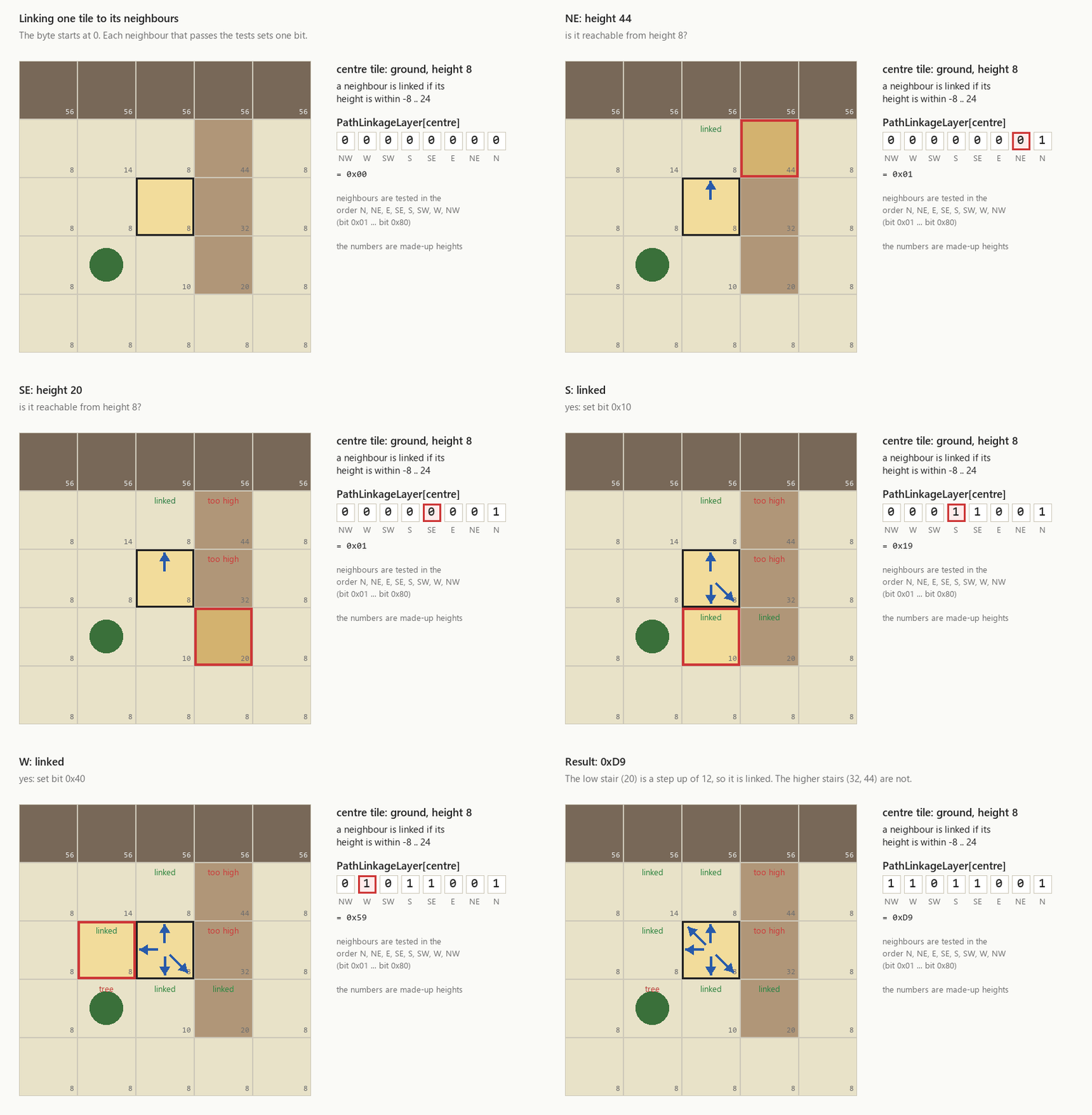
Some kinds of neighbour bypass the height rule or are never linked at all:
Neighbour has |
Outcome |
|---|---|
|
height rule |
|
never from a keep; never if the stairs’ |
|
never from a keep; never if a building stands on it; otherwise height rule |
|
never linked |
|
linked from keep tiles; from wall tiles unless the wall’s damage is above 20; never from anything else |
|
never |
|
from a keep or a gatehouse wall: linked unless the neighbour’s damage is above 20, no height rule; from a wall or stairs into a gatehouse wall: linked unless this tile’s damage is above 20; otherwise height rule |
map border ( |
never |
any other impassable flag (sea, river, rocks, tree, moat, …) |
never |
anything else |
height rule |
The DamageLayer is a per-tile byte that the game uses for several things; on farm fields, for
example, it holds the growth stage. On walls it holds the wall’s damage. So a badly damaged wall
or staircase loses its special connections.
Step 3: no squeezing through corners
Tested one by one, a diagonal step can be allowed even when both tiles beside it are blocked: a unit would slip between two walls that touch only at a corner. A second pass removes such diagonals. For a ground tile the rule is:
Remove the NE link if N and E are both blockers and neither of them is linked.
The same applies to NW (with N and W), SE (S and E) and SW (S and W).
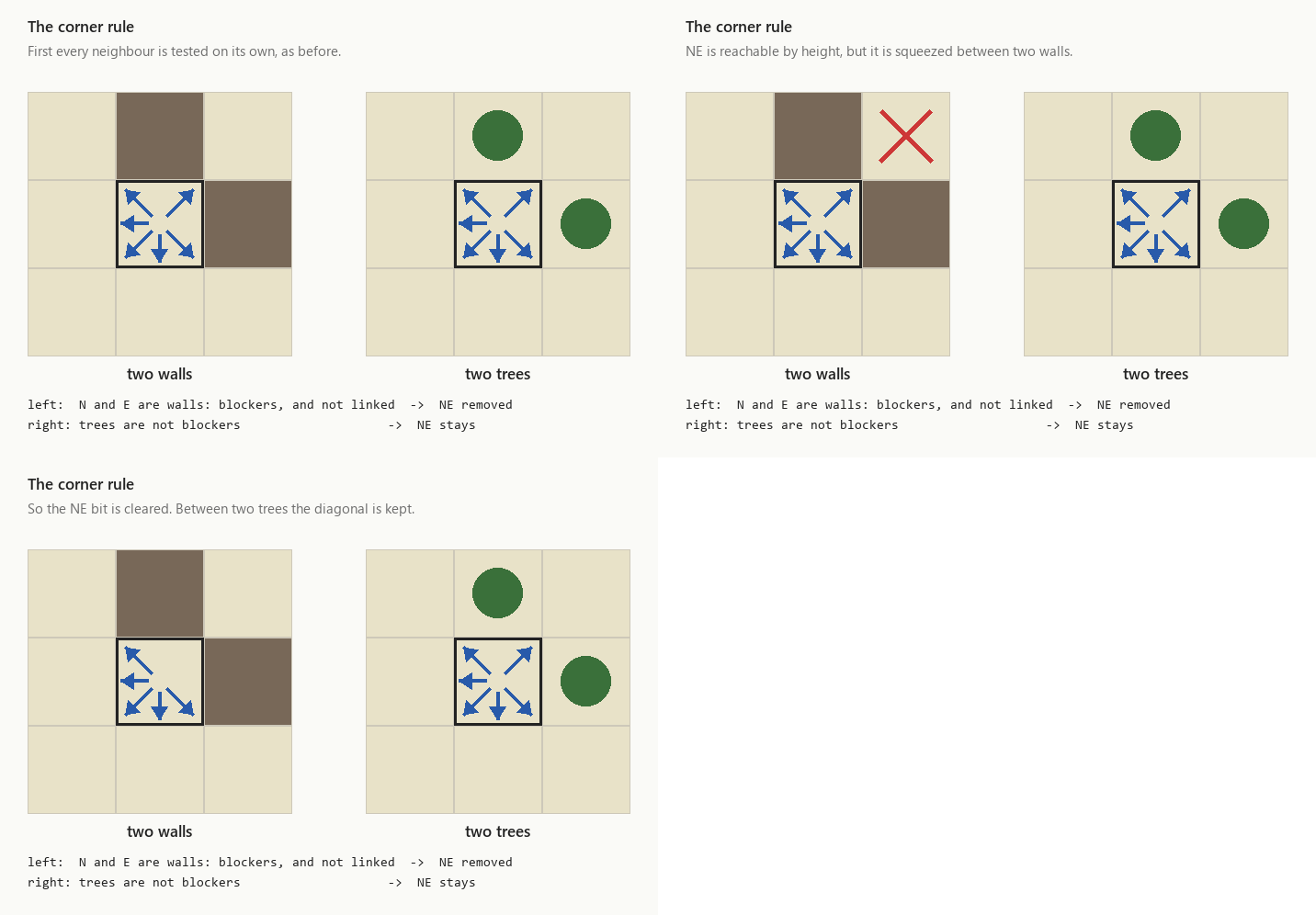
The surprise is what counts as a blocker. While testing the neighbours, the function marks only these as blockers:
walls and gatehouses,
keeps,
L_CRENEL_VARIATIONUnktiles,the map border,
buildings whose type is listed in a per-type table in the game’s data: keeps, gatehouses, towers, keep doors, barracks, mercenary post, armoury, mill, chapel, manor house, water pot, European outpost, and one unidentified type (79).
Trees, rocks, water and all other buildings are not blockers. Units may therefore step diagonally between two trees, or between two houses.
Tiles on a wall, stairs, keep or ladder use a different corner test. It removes the NE link if N and E are both wall or keep, NE is neither of those nor a stockpile, and neither N nor E is stairs. It appears to stop a unit on a wall from stepping diagonally off a wall corner.
Step 4: store the byte
The byte is written to PathLinkageLayer[tile]. The function returns TRUE if a gatehouse or a
keep stands on the tile, and FALSE otherwise. The callers below use that return value.
Building the whole layer
PathFindingState::updatePathLinkageLayerForEachBuildingAtEachTile (0x004A5F60) applies the
rule to every tile of the map, one after another. When a map is set up, the game runs it first,
then builds the areas, and then calls BuildingsState::updatePathLinkageLayerForAllBuildings. That
function hands every building to TileMapState::updatePathLinkagesForBuilding, which is not
reimplemented yet and is not covered here.
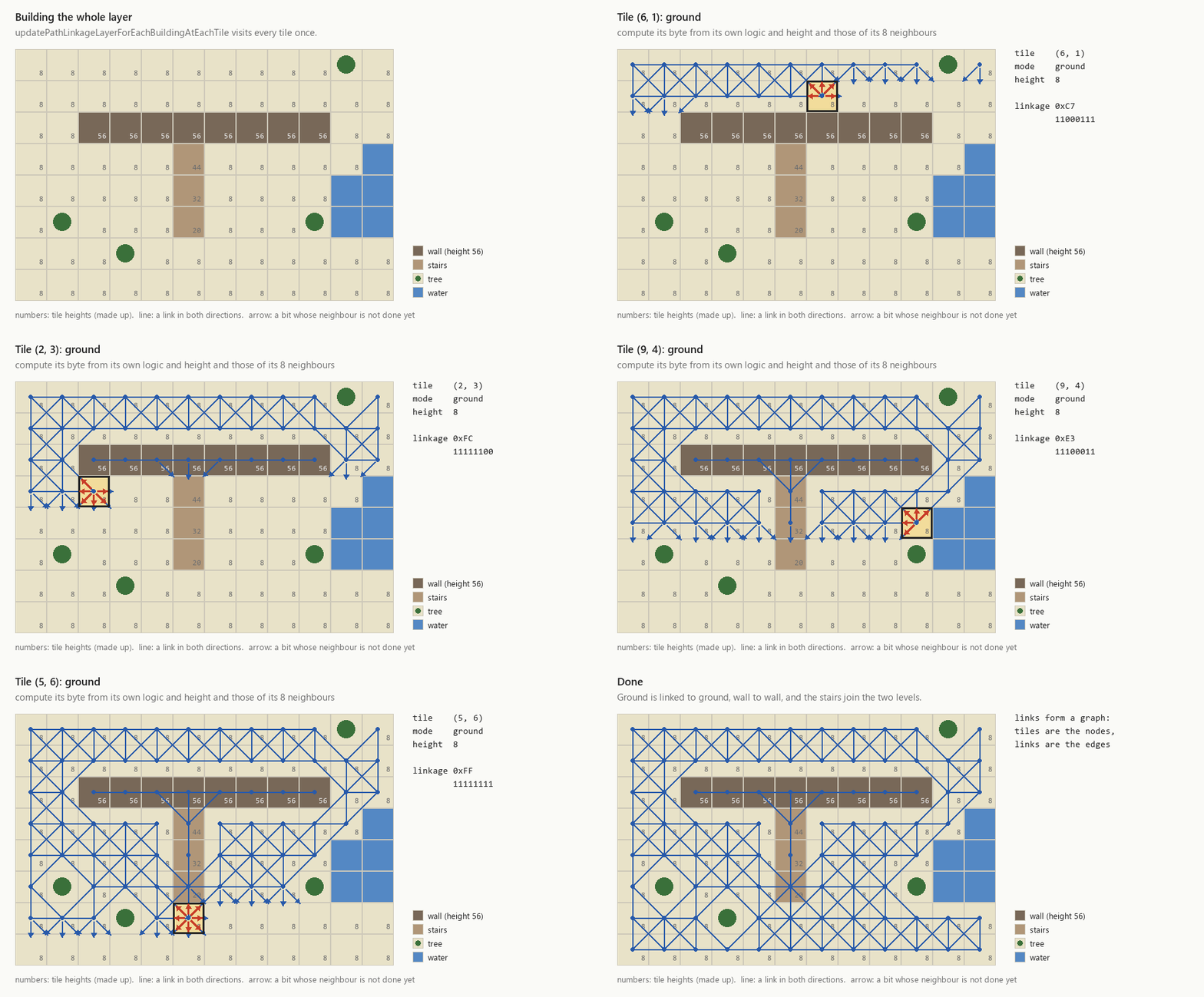
In the finished picture every link happens to be two-way, so each is drawn as a plain line. On a real map the links form one big graph: the area flood fill finds its connected pieces, and the path searches find routes through it.
Keeping it up to date
Rebuilding all 80,400 bytes whenever something changes would be wasteful. Look at what the rule reads, though: one tile’s byte depends only on that tile and its eight neighbours. So when a tile changes, only nine bytes can be affected, namely its own and those of its eight neighbours. Every other tile neither is the changed tile nor has it as a neighbour.
That is exactly what PathFindingState::updatePathLinkagesInAllEightDirections (0x004A5F90)
does. It recomputes the changed tile, then its eight neighbours. When a wall is destroyed,
destroyWall calls it for each affected tile.
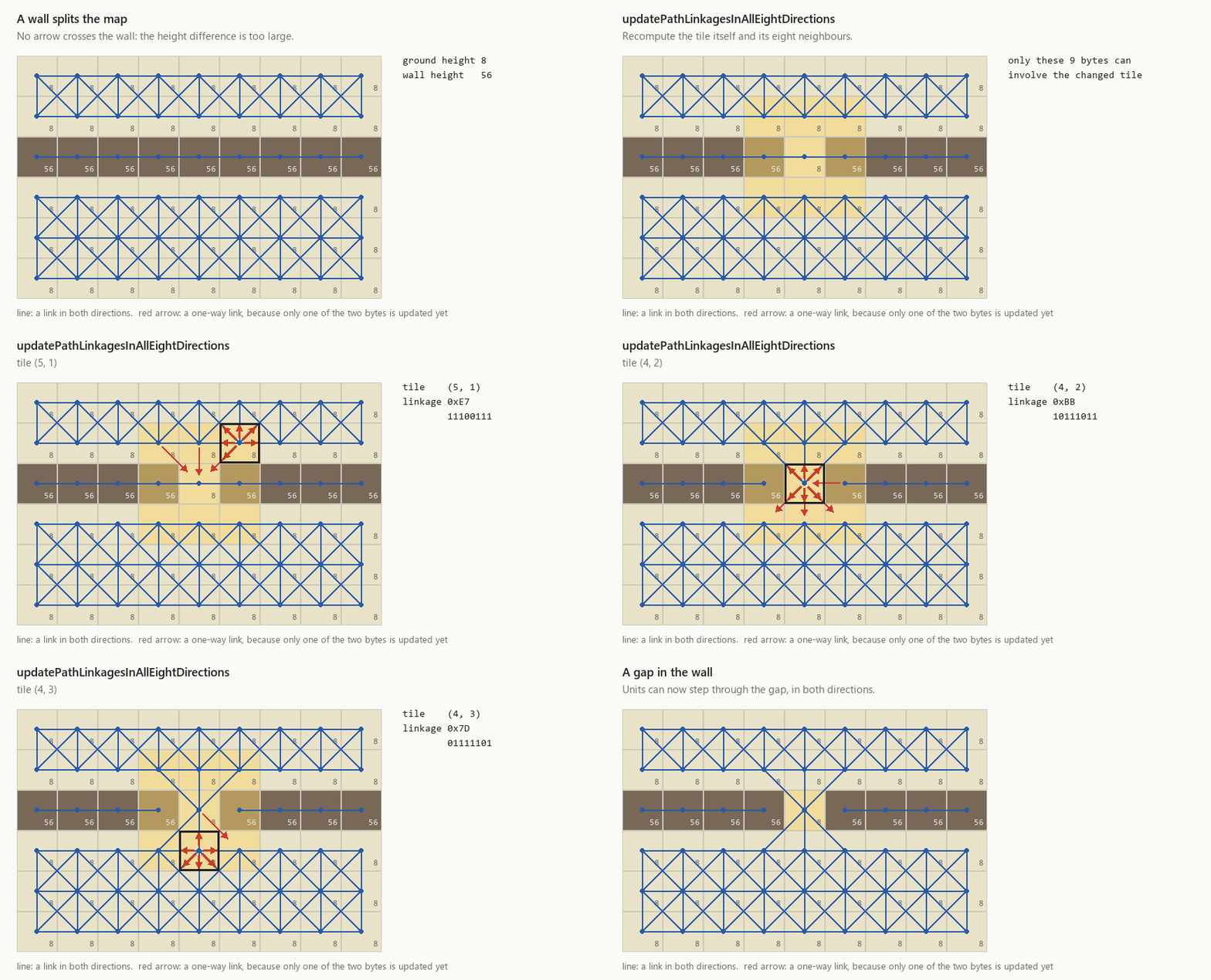
Halfway through the update some bytes are new and some still old. Briefly, links can then be one-way, the red arrows in the animation. Once all nine bytes are recomputed, the gap is linked in both directions.
If any of the nine tiles holds a gatehouse or a keep (the TRUE return value from step 4), the
function sets BuildingsState::pathLinkageKeepWasUpdatedUnk. Recomputing those tiles has just
overwritten the special links described in the next section. On the next game tick,
BuildingsState::updatePathLinkageForGatesKeepsSiegeTowers sees the flag and puts them back for
every gatehouse, keep and siege tower on the map.
Special links: gates, keeps and siege towers
The rule above knows nothing about gates opening and closing, keep entrances or siege towers. For these, small functions patch individual bits after the rule has run.
Gatehouses,
updatePathLinkageTileMapRelatedToGates(0x00499FA0). A gatehouse has two openings on opposite sides: west and east for building variation 80, north and south otherwise. At each opening the function looks at the tile just outside and the tile just inside, and sets or clears the two bits that point at each other. It clears them if the gate is closed (pathLinkageRelated2 == 2), if the outside tile is impassable, or if their heights differ by more than 16. Otherwise it sets them. Opening or closing a gate calls this function. So does the area flood fill, which closes every gate while it runs.Keeps,
updatePathLinkageTileMapRelatedToKeeps(0x0049A1C0). This sets the pair of bits between the keep’s entrance and the tile in front of it. Which pair depends on the keep’s orientation. It only ever sets bits.Siege towers,
updatePathLinkageTileMapRelatedToSiegeTower(0x0049A2E0). This sets a fixed cross-shaped pattern of north–south and east–west links across the tower’s footprint.Making a tile two-way,
updatePathLinkageLayerAtTileForSomeLogicalReason(0x00499DC0). For each neighbour that is not border or impassable, this copies the tile’s own bits onto the neighbour’s opposite bit. Afterwards every link of that tile works in both directions. We have not traced its callers yet.
Links are one-way
Because every tile computes its own byte, nothing forces A→B and B→A to agree. The height rule is symmetric (if A is within 16 of B, then B is within 16 of A), so on plain terrain the links come in pairs. Several of the special cases are not symmetric, though. Take a staircase whose damage is above 20. A ground tile next to it does not link to it, but the stair tile itself still uses the height rule and can link back to the ground.
Every reader of the layer follows only the bits of the tile it is standing on. The flood fill, for example, enters a neighbour only if the current tile has the bit for it. Keep this in mind when you read the path-finding code.
The whole rule as pseudocode
BOOL updateLinkageForTile(int y, int tile)
{
    uint logic  = LogicLayer[tile];
    int  height = HeightLayer[tile];
    if (logic & L_KEEP) height += buildingHeight(BuildingLayer[tile]);
    BOOL result = tile has a gatehouse or keep building;

    PathLinkageLayer[tile] = 0;
    mode = classify(logic);                      // step 1, first match wins
    if (mode == BLOCKED) return result;

    byte links = 0, blockers = 0;
    for (int i = 0; i < 8; i++) {                // N, NE, E, SE, S, SW, W, NW
        int n = tile + directionTranslationMatrix[y][i];
        switch (neighbourOutcome(mode, n)) {     // the neighbour table, step 2
        case NEVER:                  break;
        case NEVER_BUT_BLOCKS:       blockers |= 1 << i; break;
        case LINK:                   links |= 1 << i; break;   // keep and gatehouse cases,
                                                               // damage permitting
        case HEIGHT_RULE_AND_BLOCKS: blockers |= 1 << i; /* fall through */
        case HEIGHT_RULE:
            if (abs(HeightLayer[n] - height) <= 16) links |= 1 << i;
            break;
        }
    }
    links = removeCornerSqueezes(mode, links, blockers);   // step 3
    PathLinkageLayer[tile] = links;              // step 4
    return result;
}